Raw concrete wasn’t made to be left as a working surface. It’s porous and soaks up oil like a sponge. It also sheds dust and starts to fail at the edges first. Industrial floor coatings are the standard fix without a doubt. But the challenge is choosing one; it’s messier than reading a brochure.
Put the wrong system on a slab, and you’ll watch it fail inside a year.
But put the right one on and prepare the base properly, and it can run for far longer than anyone budgeted for.
Product matters, of course. It’s just that preparation matters more.
What You’re Asking the Floor to Do
Everyone in a plant wants something different from the same square metre:
- Operations hates dust
- Safety cares about grip
- Quality needs a surface that can be wiped
- Finance would like it to outlast the next audit
Coatings cover most of that by closing up pores and laying a wear layer over the top.
Self-levelling systems run one to two millimetres and take trolleys and forklifts without complaint. You go thicker with trowelled screeds for loading bays that get hammered every day,
So there’s no single product here. They’re just builds of different weights for different punishment. Take care not to lump them together.
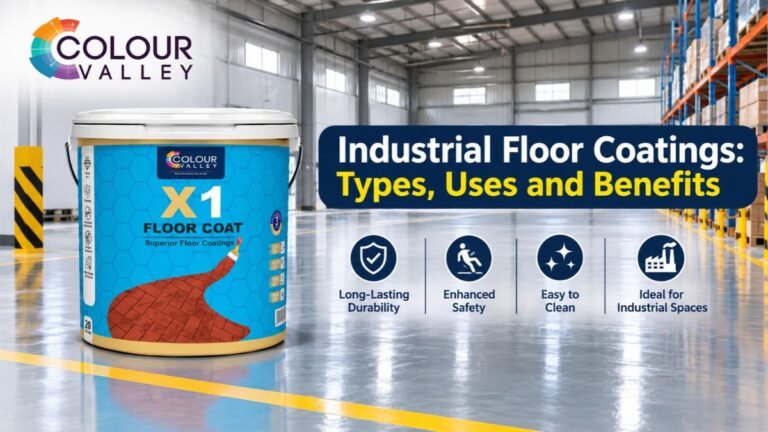
Epoxy Floor Coating, the Default Choice
Mix resin and hardener on site, and a chemical reaction takes over. This cures the film rather than letting it dry. That reaction is why epoxy grips a prepared slab so firmly.
What you end up with is hard, dense and glossy. It shrugs off abrasion and plenty of everyday chemicals.
You’ll see an epoxy floor coating in:
- Warehouses
- Workshops
- Pharma packing rooms
- Labs
- Showrooms
Cleaning is quick, and the colour choice is wide. This is why walkways and forklift lanes can be painted straight into the floor.
But there’s also a downside: it’s stiff.
Epoxy may crack or let go if the slab shifts or the temperature jumps about. Sunlight also yellows and chalks many types, which makes it unsuitable for sun-facing loading docks.
Polyurethane Floor Coating for Floors That Flex
A polyurethane floor coating gives more. Impact and temperature swings don’t crack it as easily. That is why food plants and cold rooms specify it. Many PU systems keep their colour in daylight; a few handle chemicals that attack epoxy.
PU costs more, and it’s touchier to apply. This is because moisture in the air or the slab can make it bubble. Many specifiers combine the two: epoxy underneath for strength, PU on top for flexibility and UV stability.
It’s a sound pairing if the budget allows.
A Few Others Worth Knowing
Polyaspartic is a new option. It cures quickly and has good UV behaviour, making it appealing when every hour of downtime hurts.
Acrylic floor paints are cheaper and recoat fast, which suits storage aisles.
Then there’s MMA and cementitious urethane meant for freezers and hot-wash rooms. These are the specialist end of industrial flooring solutions.
Fitting the System to the Room
The question shouldn’t be “which one’s the best” but “what happens on this exact floor on its worst day?”
Consider traffic first: walking is different from loaded forklifts on hard wheels. They chew through thin films. Spills come next. Acids, alkalis, solvents, oils and washdown detergents each behave differently on each system. Additionally, steam cleaning, a freezer door or a dock baking in the afternoon sun push on a film in its own way.
If water sits on the floor, grip and drainage supersede colour. How long the room stays shut is also a valid query; it may remove half your options.
Also, look hard at the slab itself and study its age, cracks and any oil that’s soaked in.
Moisture and Preparation (Where It Goes Wrong)
Concrete holds water. New slabs hold more water than old ones, but older ones do too when there’s no damp-proof membrane below. Vapour rises, hits a sealed coating, and builds pressure under it until the film blisters or peels.
Excess moisture in the substrate is a known reason flooring systems debond. Moisture-tolerant primers and temporary barriers can handle it, but they add cost and time.
A slab test before specifying costs less than ripping up a floor.
Coming to the surface, laitance – that weak cement skin on a fresh pour – has to go. Oil-soaked patches need treating before anything else. Cracks and spalls get repaired, and never painted over. Grinding then gives the primer a profile to bite into.
Could you skip grinding on a small patch? Technically, yes. You’ll be back to fix it, and the repair will show. Sound waterproofing and construction chemicals around the slab take care of some of the moisture risk before a coat goes anywhere near it.
Industrial Floor Protection Past the Coating Itself
A coating protects concrete. But protecting people and production is a bigger task.
The risk of slipping is there. While glossy and smooth looks good, it’s like ice with a little oil or water. Broadcasting aggregate into the wet film offers grip, though the floor gets harder to clean.
There’s a legal angle where Section 11 of the Factories Act, 1948 asks factories to:
- Clear dirt daily
- Wash floors weekly
- Drain areas that get wet in the process
A non-porous coating makes that routine realistic. Raw concrete holds onto whatever lands on it. Also, expansion and control joints should carry through the coating. The floor cracks along them regardless.
Cost and Where This Doesn’t Apply
Quotes for the same room can be “miles apart”. System choice explains some of it, thickness some more, and the rest is who’s cutting corners on prep.
For instance, a cheap coating redone every few years can outspend a better one laid once over ten years. That’s a pattern, and it fails when the space is temporary. Coating a floor you’ll leave in two years doesn’t call for a heavy build.
What should you put on the quote sheet then? Here’s what:
- Ask for the surface preparation method in writing
- The number of coats
- The dry film or total thickness
- The cure time before traffic
Two quotes that look the same on price often differ on exactly these lines. One contractor grinds the slab and primes it twice; another sweeps and rolls a single coat.
Cleanrooms, ESD-controlled electronics areas, and explosive-atmosphere zones have their own standards.
Call a flooring specialist and a structural engineer if you’re unsure about the slab.
Choosing Sensibly
Industrial floor coatings reward buyers who call out awkward things early. What’s under the slab? What gets spilt? Who drives across it and how often? Which room can’t close?
Honest answers narrow epoxy versus polyurethane versus a mix without much help.
Getting it wrong isn’t dramatic. But it’s slow. A floor that dusts, blisters and turns greasy costs cleaning hours and the occasional incident report.
Repairs mean closing areas, and nobody keeps a budget line for that.
At Colour Valley Paints, we’d rather see the site and the slab before anyone discusses a system.